Light Therapy and Aromatherapy for Sleep: The Combo
Light therapy and aromatherapy for sleep work better together. See why syncing both in one circadian protocol beats either method alone.

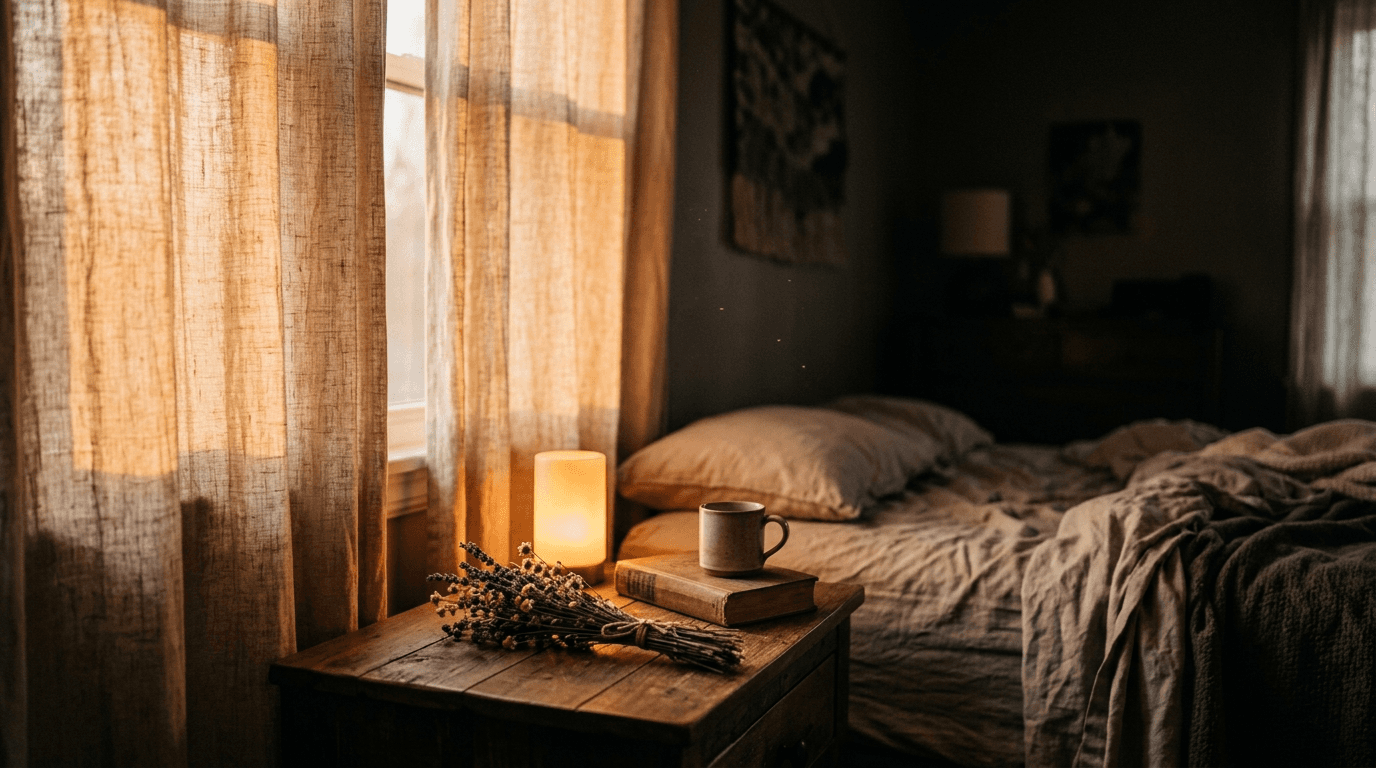
Light Therapy and Aromatherapy for Sleep: Why the Combination Works Better Than Either Alone
Most people trying to fix their sleep are solving half the problem — and wondering why nothing changes. Light therapy and aromatherapy for sleep are two of the most well-researched environmental interventions available, yet most people use one or the other, never both, and rarely at the right time.
Your body is always listening. Not to your intentions, not to your schedule, not to the melatonin gummy you took at 9pm. It is listening to your environment — the wavelength of light hitting your retina, the aromatic compounds landing on your olfactory epithelium, the soundscape your nervous system is scanning for threat. These signals have been shaping human sleep for hundreds of thousands of years. What modern life did was replace them all at once, simultaneously, with the wrong inputs. And the fix isn't a single better signal. It's a return to the full orchestra.
This post breaks down exactly why light therapy and aromatherapy for sleep work better together than either does alone — and what the neuroscience of that combination reveals about why so many single-signal sleep solutions fall short.
Light Therapy and Aromatherapy for Sleep: Your Brain Has Two Sleep Switches
The science of sleep is really the science of suppression. Your brain doesn't "turn on" sleep. It removes the things that keep you awake.
The first switch is photoentrainment — your circadian system's response to light wavelengths. The suprachiasmatic nucleus (SCN), a paired cluster of roughly 20,000 neurons sitting just above the optic chiasm in the hypothalamus, uses light input from intrinsically photosensitive retinal ganglion cells (ipRGCs) to set the body's master clock. These cells are maximally sensitive to short-wavelength blue light (~480nm). When they detect it, they suppress melatonin secretion from the pineal gland with remarkable efficiency.
A landmark study by Gooley et al. (2011) published in the Journal of Clinical Endocrinology & Metabolism found that exposure to room light in the hour before sleep suppressed melatonin by more than 90% compared to dim light conditions — and delayed melatonin onset by about 90 minutes. A single overhead light. Ninety percent suppression.
The Society for Light Treatment and Biological Rhythms (SLTBR) consensus recommends keeping evening light exposure below 10 lux in the 90-minute pre-sleep window — roughly the brightness of candlelight — to allow melatonin secretion to proceed on its natural schedule. Most living rooms run between 100 and 300 lux. Most phone screens, held close, deliver more than that directly to the most sensitive cells in your retina.
The second switch is olfactory. Inhaled aromatic compounds take a remarkably direct route into the brain. Unlike every other sensory system, olfactory input bypasses the thalamic relay and connects directly to the limbic system — specifically the amygdala, hippocampus, and hypothalamus. The pathway is not metaphorical. Aromatic molecules dissolve in the nasal mucosa, bind to olfactory receptors, and transmit signals through the olfactory bulb directly to structures that govern threat perception, emotional memory, and autonomic arousal.
Specific compounds act on specific receptors. Linalool — the primary active terpene in lavender essential oil — has been shown to modulate GABA-A receptor activity, the same inhibitory pathway targeted by benzodiazepines and many prescription sleep medications, but via inhalation rather than ingestion and without the downstream receptor desensitization that makes pharmaceutical GABA agonists problematic for long-term use. A clinical review by Koulivand et al. (2013) in Evidence-Based Complementary and Alternative Medicine confirmed lavender's anxiolytic and sedative properties across multiple trials, with consistent findings of reduced amygdala reactivity and improved subjective calm.
Cedrol, the sesquiterpene alcohol found in cedarwood and atlas cedar essential oil, operates through a related mechanism. Research has identified cedrol as a central nervous system depressant that appears to lengthen sleep duration and reduce locomotor activity in animal models — effects consistent with parasympathetic nervous system activation.
Two different input channels. Two different receptor systems. Both, when working, pulling your physiology in the same direction: down. This is what makes light therapy and aromatherapy for sleep uniquely complementary — they access separate biological pathways that converge on the same outcome.
The Synergy Mechanism — What Happens When Light and Scent Hit the SCN Together
Here is what most sleep content misses entirely.
The SCN — the same structure that processes your light environment and drives melatonin timing — also receives olfactory input. Both photic signals (via the retinohypothalamic tract) and aromatic signals (via the olfactory-limbic pathway) converge on the hypothalamus. They are not parallel systems running independently. They are inputs to the same central clock.
This convergence is precisely why light therapy and aromatherapy for sleep produce results neither achieves alone. Circadian signals are integrative. The SCN doesn't respond to one strong signal and ignore others. It weights multiple inputs simultaneously to form a coherent picture of "what time it is" for your body. When the light environment says evening (amber wavelengths, low lux) and the olfactory environment says safety and rest (GABA-A modulation, parasympathetic activation), those signals are additive. Both are telling the same timekeeper the same thing at the same time.
A 2006 study by Moss et al. examining lavender aromatherapy's effects on mood and cognition demonstrated statistically significant reductions in mental fatigue and increased contentment — outcomes consistent with downregulation of the default threat-alert state that keeps many people awake despite physical exhaustion. The mechanism matters here: these effects weren't placebo associations. They tracked with measurable changes in the autonomic nervous system.
That autonomic signature is where heart rate variability (HRV) becomes a useful proxy outcome. Specifically, RMSSD — the root mean square of successive differences between heartbeats — is the most sensitive short-term marker of parasympathetic tone. Higher RMSSD means your nervous system has successfully shifted from sympathetic dominance (alert, scanning, cortisol-mediated) to parasympathetic dominance (safe, digesting, recovery-oriented). Research has linked both reduced blue light exposure in the pre-sleep window and inhaled lavender compounds to improvements in RMSSD, suggesting both inputs work through the same final common pathway: the autonomic nervous system's decision about which state to inhabit.
When you shift light and scent simultaneously toward biological evening, you're not adding two small effects. You're reinforcing the same signal through two separate input channels to the same central clock. The circadian message becomes impossible to ignore. This is the central promise of light therapy and aromatherapy for sleep used as a coordinated protocol rather than two separate habits.
What the RCTs Actually Show About Aromatherapy and Sleep Quality
"Aromatherapy helps you relax" sounds anecdotal. The clinical data tells a more specific story.
The Lewith et al. (2005) trial published in the Journal of Alternative and Complementary Medicine examined lavender aromatherapy's effect on sleep quality in community-dwelling adults with self-reported sleep disturbances. Participants using lavender showed improvements in sleep quality scores — but with an important nuance: the effect was strongest in those with milder disturbances and weakest in those with severe, diagnosable insomnia. This tells you something useful. Aromatherapy is not a pharmacological sledgehammer. It is an environmental signal. It works best when the rest of the environment is aligned with it — which is exactly the case when light therapy and aromatherapy for sleep are used together.
A subsequent RCT by Chien et al. (2012) in Evidence-Based Complementary and Alternative Medicine used lavender inhalation in perimenopausal women with documented sleep complaints and measured outcomes via both subjective sleep quality (Pittsburgh Sleep Quality Index) and objective actigraphy. The aromatherapy group showed significant improvements in sleep efficiency and reductions in nighttime waking compared to controls. Actigraphy data is not self-report. It is movement-based objective measurement. The women were sleeping differently — not just reporting they felt more relaxed.
What both trials share is this: the participants were using scent as the only environmental intervention. No attention was paid to light. No synchronized sound. The signal was singular. And it still moved the needle.
Which raises the obvious question: what happens when you stop sending mixed signals?
Your environment and your biology are in constant communication. When that conversation is coherent — when every input in the pre-sleep window is telling the same biological story — the response is faster, deeper, and more consistent than any single-signal protocol can achieve. Light therapy and aromatherapy for sleep, applied together in the same window, make that coherence possible.
Why Single-Signal Devices Are Solving the Wrong Problem
The market for sleep devices is, at this point, enormous. Sunrise alarm clocks. Essential oil diffusers. White noise machines. Red light panels. Each of these addresses a real mechanism. None of them addresses the full picture — and more importantly, none of them is aware of the others.
A diffuser runs on its own timer, or no timer. A sunrise alarm handles light, but only at wake. A sound machine runs all night at fixed output. These devices do not know what each other is doing. They are not calibrated to your specific pre-sleep window. They are not synchronized to a biological schedule. They add signals to your room. They do not orchestrate them.
This is the gap Eden's BioSync system was designed around.
The research on photic entrainment is explicit about timing: the 90-minute pre-sleep window is when light wavelength shifts matter most. The research on olfactory priming points to the same window — the amygdala's threat-suppression response to linalool is most useful when your nervous system is deciding whether to stay alert or begin its descent. The entire case for light therapy and aromatherapy for sleep rests on stacking both interventions into that same window, synchronized — because that is what the convergence mechanism in the SCN actually requires.
Eden delivers amber-shifted light, timed diffusion of sleep-specific essential oil blends, and a layered soundscape — not as separate functions, but as a single coordinated protocol that begins at the same moment each evening and phases out in the same biological sequence. No phone in the room. No app open on the nightstand. No manual timing required. The environment shifts automatically because the research is clear about when it needs to shift, and doing it manually is the reason most people don't do it consistently.
Reclaim the sacred windows. The 90 minutes before you intend to sleep are not downtime. They are the biological preparation that determines whether sleep, when it arrives, is restorative or merely unconscious. Every competitor on the market asks you to solve one signal. Eden orchestrates all three simultaneously, on a timed biological schedule, because that is what the convergence science actually requires.
The Eden device is available at edenos.io/shop/eden-device for anyone ready to stop experimenting with signals in isolation.
Building a Sleep Routine Around Light Therapy and Aromatherapy for Sleep
If you understand the mechanisms, building an effective pre-sleep environment becomes less about following rules and more about respecting biology.
Light first. The single highest-leverage change most people can make is eliminating overhead white light after 8pm. Warm, amber-toned light below 10 lux stops the active suppression of melatonin. You don't need to do anything special. You need to stop doing the thing that's working against you. Scent second — and specifically. Not every essential oil is appropriate for sleep. The research clusters around specific compounds: linalool (lavender, lavandin), cedrol (cedarwood, atlas cedar), and certain monoterpenes in roman chamomile. Synthetic fragrances typically don't contain the active terpenes in biologically meaningful concentrations. An aromatherapy diffuser for sleep use should be running genuine essential oils, timed to your pre-sleep window, not running all night — because receptor saturation is real, and the signal matters most in the transition period. Sound as a buffer, not a feature. Your nervous system evolved to scan ambient sound for threat. White noise, pink noise, and certain low-frequency nature sounds reduce the perceptual salience of intrusive sounds — effectively lowering the threshold your amygdala needs to trigger an arousal response. This is particularly important if you live in an urban environment or sleep with a partner on a different schedule. Consistency over intensity. The circadian system is a clock. It learns through repetition. A moderate, consistent signal delivered at the same time each evening is more effective than a powerful signal delivered randomly. This is why the research on light therapy and aromatherapy for sleep consistently shows stronger effects in trials with fixed protocols than in studies where participants self-administered interventions on their own variable schedules. It is also why light therapy and aromatherapy for sleep work best when treated as a unified nightly practice rather than two separate habits you remember on alternating evenings.
Return to your natural rhythm — not by rejecting modern life entirely, but by being deliberate about the 90 minutes where your biology is most listening. That window is not a lifestyle upgrade. It's a biological requirement that modern environments have quietly dismantled.
FAQ
Does aromatherapy actually help sleep, or is it just placebo?
The effect is real, but the mechanism is specific. Inhaled aromatic compounds — particularly linalool in lavender — bind to GABA-A receptors via the olfactory-limbic pathway, suppressing amygdala activity and shifting the autonomic nervous system toward parasympathetic dominance. This is a pharmacological mechanism, not a placebo response. The Chien et al. (2012) RCT demonstrated improvements in objective, actigraphy-measured sleep efficiency — not just self-reported relaxation. The effect is moderate in isolation. It becomes substantially more pronounced when light therapy and aromatherapy for sleep are combined in the same pre-sleep window, with a consistent, aligned light environment reinforcing the olfactory signal.
What essential oils are best for deep sleep specifically?
The research most consistently supports lavender (specifically linalool-rich varieties), cedarwood (for cedrol content), and roman chamomile. For diffuser use in a sleep context, single-compound purity matters more than blend complexity — you want meaningful concentrations of the active terpenes, not trace amounts diluted across twenty ingredients. Avoid eucalyptus and peppermint in the pre-sleep window; their primary compounds (1,8-cineole and menthol respectively) have stimulant properties at olfactory concentrations.
How does light therapy for sleep actually work — and what kind of light helps?
Light therapy for sleep works by manipulating melatonin timing through the SCN's photoentrainment pathway. Blue-wavelength light (~480nm) activates ipRGCs in the retina, which signal the SCN to suppress pineal melatonin output. Shifting your evening light environment to amber wavelengths (above ~590nm) and reducing overall lux below 10 removes that suppressive signal and allows your natural melatonin curve to rise on schedule. This is not about "special" therapeutic light devices at night — it's about removing the wrong light. The therapeutic application of bright, blue-enriched light belongs to morning exposure, which sets the circadian anchor point that determines when your evening melatonin rise will occur. This is why light therapy and aromatherapy for sleep pair so effectively: light governs the timing, and scent reinforces the biological state.
Why does combining light and scent work better than using them separately?
Both photic input (via the retinohypothalamic tract) and olfactory input (via the olfactory-limbic pathway) converge on the SCN and hypothalamus — the same structures that drive circadian timing and autonomic state. When both signals are delivered simultaneously in the pre-sleep window, and both signals communicate "biological evening," the circadian message is reinforced through two independent input channels to the same central clock. The result is faster parasympathetic shift, more consistent melatonin onset timing, and deeper descent into the early sleep stages than either signal produces alone. Light therapy and aromatherapy for sleep, used together on a fixed nightly schedule, give your circadian system the clearest possible signal that it is time to descend.





on
Apr 3, 2026
Sleep optimization stripped of supplements and hype — the two systems that control sleep, what actually improves sleep architecture, and the integration problem every single-signal product ignores.
on
Apr 3, 2026
An honest evaluation of every sleep technology category — sunrise alarms, white noise machines, cooling mattresses, diffusers, and multi-modality systems — through the lens of the actual mechanisms.
on
Apr 3, 2026
The neuroscience behind insomnia, circadian rhythm disorders, sleep apnea, and the 3am wake — what is actually happening, and what the evidence says about environmental versus pharmacological approaches.