Circadian Rhythm and Essential Oils: Timing Is Everything
Your circadian clock responds to scent — but timing matters most. Learn when to diffuse essential oils to unlock deeper, more consistent sleep.

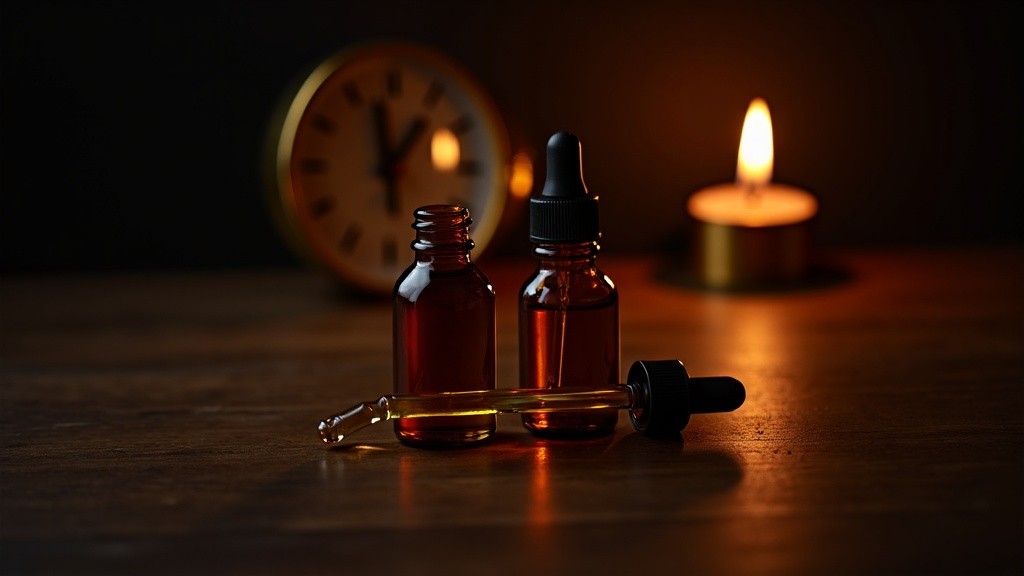
Your Circadian Rhythm and Essential Oils: Why When You Diffuse Matters More Than What You Diffuse
Most people buy lavender oil, diffuse it whenever, and wonder why their sleep doesn't change. The problem isn't the oil — it's the timing. Understanding the relationship between circadian rhythm and essential oils is the missing piece in nearly every aromatherapy guide written for sleep. Your body is always listening. Not just to light, not just to temperature, but to scent. And buried in nearly two decades of chronobiology research is a finding that most aromatherapy guides completely ignore: the biological window in which you introduce a calming scent to your environment determines whether that scent works with your circadian clock — or lands in the silence of an unresponsive system.
This is the piece no one is telling you.
The Clock Inside You Is Running on Light — and It's More Fragile Than You Think
Somewhere deep in your hypothalamus, roughly above the point where your optic nerves cross, sits a cluster of about 20,000 neurons called the suprachiasmatic nucleus. The SCN is your master circadian clock. It doesn't just track time — it is time, at least as your body experiences it.
Reppert and Weaver's foundational 2002 review in Nature Reviews Neuroscience established the molecular architecture of this system with remarkable precision: the SCN receives direct photic input from a specialized subset of retinal cells called intrinsically photosensitive retinal ganglion cells (ipRGCs), and it uses that light signal to entrain every peripheral clock in your body — your liver, your adrenal glands, your skin, your gut. Every cell has a clock. The SCN is the conductor.
What this means in practice: your body's 24-hour rhythm is continuously sculpted by the light hitting your eyes. Morning light drives alertness hormones. Evening darkness cues melatonin release from the pineal gland. And that light-dark boundary — the transition from day to night — is one of the most biologically important moments in your 24-hour cycle. It is the signal that tells every downstream process: wind down now.
Here's the problem. Modern life has almost completely erased that boundary.
Research from the Harvard Medical School's Division of Sleep Medicine, building on Brainard et al.'s landmark photoreceptor studies, demonstrated that short-wavelength blue light — the light dominant in LED screens, overhead fluorescents, and most indoor lighting after dark — suppresses melatonin production with extraordinary efficiency. The dose-response curve is steep. Even moderate blue-light exposure in the two hours before sleep can delay melatonin onset by 90 minutes or more.
You're not struggling to sleep because you're anxious or broken. You're struggling because your environment has hijacked the most sensitive biological signal your body relies on, every single night.
Your Nose Has a Direct Line to Your Sleep Clock
Here's where the story gets genuinely surprising — and where the conversation about circadian rhythm and essential oils gets a lot more interesting.
Scent doesn't just produce a pleasant feeling. Olfactory input travels a neurological path that runs directly through structures intimately connected to your circadian system.
When aromatic molecules bind to receptors in the olfactory epithelium, the signal travels along the olfactory nerve to the olfactory bulb — and from there, unlike every other sensory system, it bypasses the thalamus entirely and connects directly to the amygdala and the hippocampus. This is why smells trigger memories with a vividness that no other sense can match. It's also why scent has leverage on the limbic system that visual or auditory input simply doesn't have.
Research on olfactory-limbic-hypothalamic pathways by Masaoka and colleagues mapped how olfactory signals cascade through the amygdala and into the hypothalamus — the same structure that houses the SCN. This is not a small anatomical coincidence. The hypothalamus is the crossroads of circadian timing, stress response, autonomic function, and hormonal release. When a scent reaches it, it isn't just creating a mood. It's speaking to the system that governs when your body decides it's time to sleep.
Your environment and your biology are in constant communication. The question is: what is your environment saying to your hypothalamus at 9 PM?
For most people, the answer is: blue light from a laptop screen, the cortisol residue of a stressful day, and silence from an olfactory system that evolved to receive nighttime cues it stopped getting thousands of years ago. This is precisely why circadian rhythm and essential oils research has attracted serious attention from chronobiologists — scent is one of the few environmental inputs we can consciously control in the evening hours.
Why the Specific Oils Matter — and the Mechanisms Behind Them
The aromatherapy market is flooded with claims. "Promotes relaxation." "Supports restful sleep." Most of it is marketing dressed in wellness language. But underneath the noise, there is real pharmacology — and specific compounds with specific documented mechanisms. When we talk about circadian rhythm and essential oils, the compounds doing the biological work are far more specific than "lavender" or "calming blend."
Lavender and Linalool
The most studied aromatic compound in sleep research is linalool, the primary bioactive constituent of Lavandula angustifolia (true lavender). Its effects are not vague or subjective.
A 2006 study by Goel and Lao in Physiology & Behavior documented that lavender inhalation significantly reduced sympathetic nervous system activity — measurable through heart rate variability and skin conductance — in healthy adults. The effect was specific to the parasympathetic shift that precedes natural sleep onset. Koulivand, Khaleghi Ghadiri, and Gorji's 2013 review in ISRN Psychiatry consolidated the evidence further, confirming that linalool modulates GABA-A receptor activity in a manner that mirrors the mechanism of prescription anxiolytics — but without the receptor downregulation or dependency that pharmacological interventions carry. It also documents consistent reductions in salivary cortisol following lavender inhalation, which is significant because elevated evening cortisol is one of the most reliable predictors of sleep-onset difficulty. The connection between scent and melatonin production runs through this cortisol pathway: as linalool suppresses evening cortisol, it removes one of the primary hormonal barriers to melatonin release.
The mechanism, plainly stated: linalool tells your nervous system to stop bracing. It reduces the cortisol signal that keeps your system on alert, and it does this through a receptor pathway your body already uses for inhibitory signaling.
Cedarwood and Cedrol
Less famous than lavender but potentially more relevant to the circadian wind-down window specifically, cedarwood contains a sesquiterpene called cedrol.
Kagawa and colleagues' 2003 study observed that cedrol inhalation produced measurable sedative effects, including reductions in heart rate and respiratory rate, in both human subjects and animal models. What's notable is the speed of onset — cedrol's autonomic effects appear within minutes of inhalation, making it particularly suited to the transition period between wakefulness and sleep, rather than as a background ambient scent.
Where lavender works on the stress axis (cortisol, sympathetic arousal), cedarwood seems to work more directly on the autonomic brakes — slowing the system down through a distinct pathway. Used together, they address the circadian wind-down from two angles simultaneously. This layered approach — using essential oils for sleep timing rather than as a generic ambient scent — is the core principle that separates effective protocols from ineffective ones.
The DLMO Window: The Most Underused Concept in Circadian Rhythm and Essential Oils Protocols
This is the mechanism that changes everything about when you should be diffusing.
DLMO stands for Dim-Light Melatonin Onset. It refers to the point in the evening — typically occurring approximately two hours before your natural sleep time — when your pineal gland begins its melatonin secretion in response to declining environmental light. For someone who naturally sleeps at 11 PM, DLMO typically begins around 9 PM.
DLMO is not when you fall asleep. It's when your body begins preparing to fall asleep. It is the opening of the circadian wind-down window. And it is almost universally ignored by people who diffuse essential oils "at bedtime" — meaning at the moment they're already lying down, when the biological transition they needed to support began 90–120 minutes earlier. Applying circadian rhythm and essential oils thinking to this window — rather than to bedtime — is the single most impactful shift you can make.
Here's where the science gets compelling, even though the direct RCT has yet to be done: if linalool reduces cortisol and shifts autonomic balance toward parasympathetic dominance, and if the DLMO window is precisely when the body is attempting to execute that same cortisol-to-melatonin handoff, then introducing linalool during the DLMO window is mechanistically aligned with what your biology is already trying to do. The scent becomes a supporting signal, not a standalone intervention. This is the foundational logic of essential oils for sleep timing: match the chemistry of the compound to the biology of the moment.
This isn't established as a completed clinical finding — no randomized controlled trial has yet tested DLMO-timed aromatherapy as a discrete protocol. But the pathway is there. The olfactory-hypothalamic connection is documented. The cortisol-reducing mechanism of linalool is documented. The timing of DLMO is precisely established. That these three pieces have not yet been formally combined in a clinical trial does not mean the mechanism isn't real. It means the research is catching up to the logic.
The practical implication is immediate: start your calming scent diffusion two hours before you intend to sleep, not when your head hits the pillow.
Why Light Therapy and Aromatherapy Have to Work Together — Not Separately
Here's where single-signal approaches reveal their fundamental limitation.
You can diffuse the most precisely formulated lavender-cedarwood blend at the exact right moment in your DLMO window — and simultaneously expose yourself to the blue-light wavelengths from your television or phone that are actively suppressing the melatonin your circadian clock is trying to release. Those two signals cancel each other at the physiological level. The scent is pushing the parasympathetic system forward; the light is holding back the hormonal response that makes that shift meaningful. The interaction between light therapy and aromatherapy isn't optional — it's the entire game.
The SCN's photic entrainment mechanism does not negotiate. Blue light in the 460–480nm range activates melanopsin in ipRGC cells and sends an unmistakable "day" signal to the suprachiasmatic nucleus. That signal delays melatonin onset at the pineal gland with documented dose-dependent precision. No amount of lavender oil counteracts a bright screen two feet from your face.
This is the gap that most sleep products — and most aromatherapy guides — simply ignore. They are solving one signal. One lever in a system that requires coordinated input. When you understand both sides of the light therapy and aromatherapy equation, the design requirement becomes obvious: the light transition and the scent diffusion have to be synchronized, not sequential afterthoughts.
Eden's BioSync system was designed around exactly this research. Rather than asking you to manually dim your lights and start a diffuser and put on a sound machine and remember to do it two hours before sleep without using your phone — the BioSync approach synchronizes warm-light wind-down (eliminating the blue-light interference at the SCN level), timed scent diffusion (beginning at your personalized DLMO window), and ambient sound into a single, automatic environmental shift. The light and the scent drop simultaneously. The circadian signal is coherent. Your hypothalamus receives a unified message: night is here.
No phone. No manual timing. No fragmented single-signal interventions that undermine each other.
That's the difference between using aromatherapy and applying it to the biology it's actually capable of affecting.
The Practical Reality: What Circadian Rhythm Sleep Tips Actually Look Like When Applied to Scent
If you want to use this science without a dedicated device, the principles still apply. These circadian rhythm sleep tips are not about perfection — they're about aligning your environment with the biological sequence your body is already trying to execute.
Two hours before your target sleep time: Begin diffusing. Not a quick spritz, not an hour of diffusion — start two hours out. This is the DLMO window. Your cortisol should already be declining naturally; lavender supports that decline. Your melatonin secretion is beginning; removing blue-light interference lets it rise unimpeded. This is the core of all practical circadian rhythm and essential oils application. Light management first: If you're diffusing lavender at 9 PM while sitting under bright overhead lights watching an LED screen, you've already compromised the most important lever. Eliminate or dramatically reduce blue-light sources before or at the same moment you start diffusing. Candle light, amber-tinted bulbs, or warm-spectrum lamps in the 2700K range are the closest environmental analog to natural evening light. Layer cedarwood into the final 30–45 minutes: Given cedrol's faster autonomic effect, adding a cedarwood component — either through blending or through a second diffusion phase — closer to your actual sleep time layers the mechanisms. Linalool addressed the stress axis earlier in the window. Cedrol addresses the autonomic brakes in the final approach to sleep. Consistency is the signal, not the substance: Your olfactory system is a prediction machine. After consistent use, the scent itself becomes a conditioned cue for the biological state you're creating — a Pavlovian circadian anchor. The first three nights it's pharmacology. By the fourteenth night, it's also memory and expectation, adding a psychological layer on top of the physiological one. This is one of the most underappreciated circadian rhythm sleep tips in the literature: repetition converts a pharmacological tool into a behavioral one.
Reclaim the sacred windows. The two hours before sleep are not dead time. They are arguably the most biologically consequential two hours in your day. Your body is executing a complex hormonal and neurological transition, and your environment is either supporting it or undermining it.
FAQ
Does aromatherapy actually help sleep, or is it just placebo?
The evidence suggests both mechanisms are operating — and that doesn't undermine the effect, it strengthens it. Linalool's modulation of GABA-A receptors and its documented reduction of salivary cortisol are measurable, physiological outcomes, not self-reported mood improvements alone. The connection between scent and melatonin production is real: as evening cortisol falls in response to linalool, the hormonal conditions for melatonin release improve. Koulivand et al.'s 2013 review in ISRN Psychiatry synthesized multiple controlled studies showing objective improvements in sleep metrics. The placebo component — the conditioned response your olfactory system builds over weeks of consistent use — is an additional mechanism, not a replacement for the pharmacology. When you smell lavender after two weeks of using it before sleep, your nervous system begins anticipating the state that followed. That's not placebo. That's learning.
What essential oils are best for sleep, and should I blend them?
Lavender (for linalool's cortisol-reducing and GABA-A activity) and cedarwood (for cedrol's autonomic sedative effects) are the two best-evidenced individual compounds. They address different but complementary mechanisms, which makes blending them logical rather than redundant. Roman chamomile, bergamot, and sandalwood have supporting evidence but smaller research bases. The more important variable than which oil is which window — beginning two hours before sleep targets the DLMO opening; cedarwood-heavy blends are more suited to the final 30–45 minutes before sleep. Any serious approach to circadian rhythm and essential oils has to treat timing as the primary variable, not oil selection.
Can I just use a candle or reed diffuser instead of an electric diffuser?
The limitation of passive diffusion methods — reed diffusers, candles, sachets — is consistency of concentration. Your olfactory receptors adapt quickly; a steady low-level scent essentially disappears from conscious








on
Apr 3, 2026
Sleep optimization stripped of supplements and hype — the two systems that control sleep, what actually improves sleep architecture, and the integration problem every single-signal product ignores.
on
Apr 3, 2026
An honest evaluation of every sleep technology category — sunrise alarms, white noise machines, cooling mattresses, diffusers, and multi-modality systems — through the lens of the actual mechanisms.

on
Apr 3, 2026
The neuroscience behind insomnia, circadian rhythm disorders, sleep apnea, and the 3am wake — what is actually happening, and what the evidence says about environmental versus pharmacological approaches.